Trentham Padel: Lean, Hybrid and Traditional Staffing Scenarios
Project: Six-court indoor padel venue near Trentham, Stoke-on-Trent
Purpose: Compare genuine operating coverage, not merely reception headcount
Evidence date: 7 August 2026
Currency: GBP per year unless stated
Decision: Open with the hybrid model. It uses five employees across 3.25 payroll FTE, staffs approximately 59 of 108 public clock-hours per week, and confines juniors, coached programmes, alcohol, events and higher-risk work to staffed blocks. Routine booking, entry, lighting, payments and first-line fault triage are automated or remote; physical incidents retain a named local response.
The analysis supports the user's central hypothesis: a padel venue does not need someone permanently sitting at reception to take payments, issue keys or turn lights on. It does not support a fiction that automation removes cleaning, emergency response, safeguarding, stock, maintenance, coaching, compliance or customer-exception work. The cost advantage comes from buying those duties at the right time and in the right form—not pretending they no longer exist.
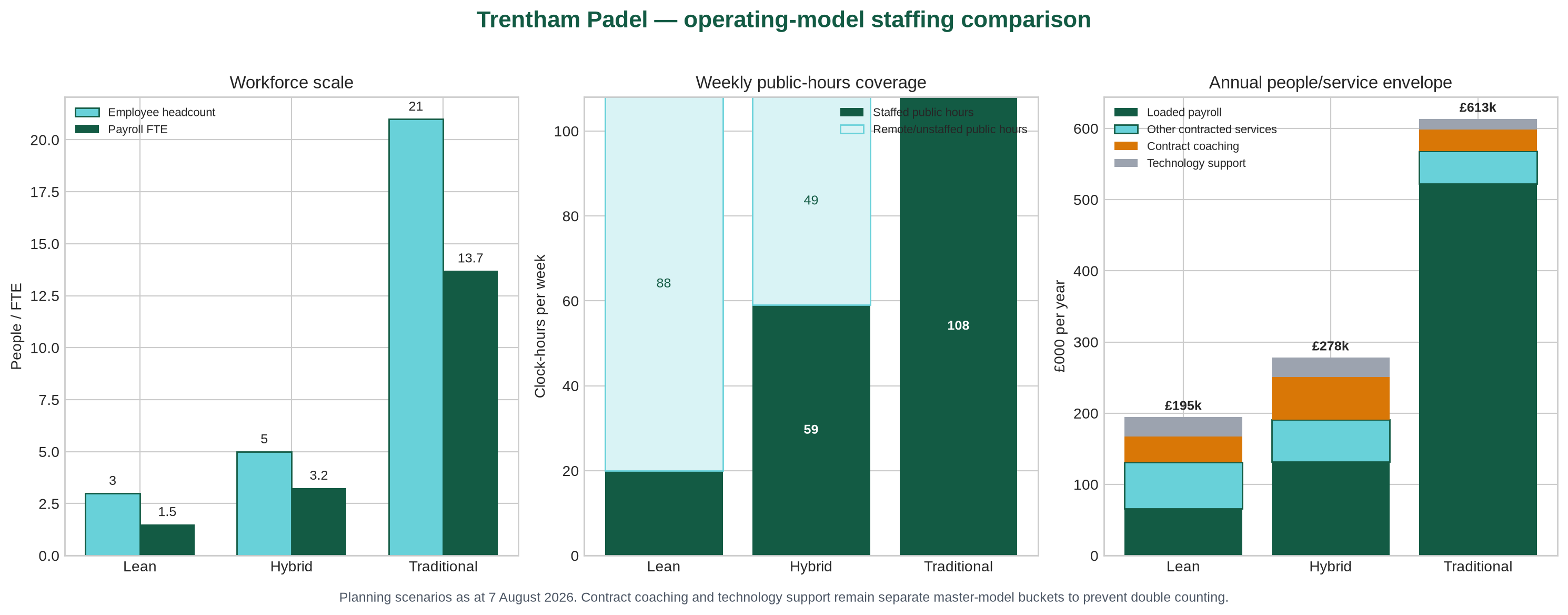
1. Decision summary
| Metric | Lean | Hybrid—recommended | Traditional |
|---|---|---|---|
| Employees on payroll | 3 | 5 | 21 |
| Payroll FTE | 1.50 | 3.25 | 13.70 |
| Staffed public clock-hours/week | 19.95 | 59.01 | 108.00 |
| Remote/unstaffed public clock-hours/week | 88.05 | 49.00 | 0.00 |
| Minimum public person-hours/week | 19.95 | 113.01 | 208.00 |
| Gross employed pay | £55,500 | £109,750 | £435,400 |
| Loaded employed payroll | £66,286 | £131,953 | £522,392 |
| Contracted people and services | £128,300 | £146,300 | £90,900 |
| All people/service envelope | £194,586 | £278,253 | £613,292 |
| Core people/services excluding technology and contracted coaching | £131,286 | £190,953 | £568,392 |
The hybrid model reduces the annual all-people/service envelope by approximately £335,039 and payroll FTE by 10.45 versus the traditional design. That is a planning comparison, not a guaranteed saving: the traditional case provides a much broader café/bar, coaching, community and continuous-attendance offer. The lean case saves another approximately £83,667 versus hybrid but leaves 88 public hours each week in remote mode and is not recommended as the opening service proposition.
The contracted-services total deliberately includes technology support and coaching payments. Those amounts remain separate master-model buckets: £27,300 is this staffing workbook's own annual allowance for running the remote-operations architecture doc 04 designs (support contracts, connectivity, monitoring — doc 04 sets the architecture, this workbook costs operating it), and £60,000 contracted coaching must be modelled against coaching revenue. They must not be added twice.
2. Why FTE, headcount and coverage are different
One payroll FTE is modelled as 1,950 paid hours per year. That does not equal 1,950 hours of public coverage because paid leave, training, sickness, handover, administration and absence cover consume time. Likewise, a 21-person operation can be only 13.7 FTE when part-time staff are used, and three employees can total only 1.5 FTE.
| Measure | Meaning | Common modelling error |
|---|---|---|
| Headcount | Number of individual employees | Treating 20 people as 20 FTE |
| Payroll FTE | Contracted annual paid hours divided by 1,950 | Assuming every paid hour is available at the front desk |
| Staffed clock-hours | Public time with at least one person on site | Ignoring peak overlap and multiple simultaneous duties |
| Public person-hours | Staffed clock-hours multiplied by minimum simultaneous people | Assuming one person can supervise juniors, run a bar, respond to an injury and manage reception at once |
| Contracted cover | Cleaning, coaching, monitoring and specialist support bought externally | Presenting low employee FTE as a zero-labour venue |
The final rota must be built from duties and demand. A person may cover host, retail and duty-manager tasks during a quiet staffed hour, but the model only combines roles where the duties are compatible. Peak coaching, hospitality and event periods require overlap.
3. Legal and safety boundary
The Health and Safety (First-Aid) Regulations require adequate and appropriate equipment, facilities and personnel for employees, determined by a first-aid-needs assessment. HSE strongly recommends including the public and children, but it does not state that every employee must hold First Aid at Work or prescribe one universal sports-venue staffing ratio.1
Lone working is not prohibited. The employer must identify and control the additional risks for employees, contractors and self-employed people working without close supervision.2 The lean and hybrid models therefore need distinct staffed and remote/unstaffed operating modes, each with permitted activities, monitored systems, emergency instructions, response routes and closure triggers.
The Fire Safety Order makes employers, owners, occupiers and others with control responsible for the fire risk assessment, suitable measures, emergency plan and staff information/training.3 It does not by itself validate an unattended building. The fire engineer, risk assessment, building control, insurer, alarm design, occupancy and means of escape must approve the final unstaffed mode. Escape cannot depend on cloud software or a remote unlock.
Automation boundary: a remote operator can verify a booking, talk to a customer, issue a one-time release, refund, reboot an approved device, isolate a court or call emergency services. They cannot administer first aid, clean contamination, assess cracked glass, secure a failed door, supervise juniors or de-escalate an intoxicated customer.
4. Scenario A: lean remote-first operation
The lean case is included because it tests the user's lowest-staff hypothesis honestly. It is not the recommended opening model for a venue with a café/bar, junior programme and community proposition.
| Component | Lean design |
|---|---|
| Employees | One General Manager/Responsible Operator and two part-time site runners, totalling 1.5 FTE |
| Public staffing | Approximately 20 hours/week, concentrated in programmed visits, selected hosted sessions and events |
| Remote period | Approximately 88 public hours/week |
| Cleaning | Contracted daily/scheduled service |
| Coaching | Contracted coaches; each engagement assessed for tax and employment status |
| Hospitality | Vending and narrow authorised service during selected staffed blocks; no unattended alcohol |
| Security/support | Event-led monitored CCTV/alarm, remote duty and local keyholder/site responder |
| Principal weakness | Delayed physical response, weak beginner/community presence and high reliance on disciplined systems and contractors |
The lean payroll costs approximately £66,286 loaded, but the complete people/service envelope is approximately £194,586 once cleaning, coaching, monitoring, marketing, payroll/HR and maintenance are visible. This difference is the strongest warning against advertising an “unstaffed” venue as a one-person business.
No junior programme, staffed food service, alcohol sale, planned event, high-risk maintenance or activity requiring physical supervision is scheduled in an unstaffed block. If the main door cannot secure, help point fails, alarm signalling is impaired, lighting/egress is unsafe, a court is damaged or required monitoring is unavailable, the remote duty manager suspends new admission and relocates/refunds bookings.
5. Scenario B: hybrid peak-staffed operation
The hybrid model provides the best balance between lower labour cost and a credible club experience. It has one General Manager, one Operations/Duty Manager and three part-time cross-trained hosts, totalling 3.25 payroll FTE.
| Period | Default operating mode | Human coverage |
|---|---|---|
| Weekdays 07:00–09:00 | Remote court-only | Programmed cleaner/site-runner overlap only |
| Weekdays 09:00–16:00 | Lean hybrid | Management, deliveries, maintenance and programmed sessions; not continuous attendance |
| Weekdays 16:00–22:00 | Staffed social peak | Minimum two-person duty/host coverage, with coaches or hospitality overlap as required |
| Weekdays 22:00–23:00 | Remote final court-only or close | Bar/shop secured before staff leave; remote close monitoring |
| Weekends 08:00–10:00 | Remote court-only or staffed programme setup | No unsupervised junior activity |
| Weekends 10:00–18:00 | Staffed programme peak | Two-person minimum plus coaching/hospitality/event overlay |
| Weekends 18:00–22:00 | Staffed social period | Two-person minimum where licensed service operates |
These blocks create approximately 59 staffed clock-hours but 113 public person-hours per week because the principal peak periods use two simultaneous people. Coaches and hospitality staff can add further coverage but are not silently counted as duty management unless trained, rostered and authorised for that role.
The employed workforce costs approximately £131,953 loaded. Contracted cleaning, coaching, monitoring, content, payroll/HR and specialist maintenance add £146,300, creating a visible all-people/service envelope of £278,253. The master model should use £190,953 as the core staffing/people-services subtotal, then add technology and coaching in their respective modules.
5.1 Hybrid role design
| Role | Headcount / FTE | Primary accountability |
|---|---|---|
| General Manager / Responsible Operator | 1 / 1.00 | P&L, compliance, partnerships, supplier performance, people and senior on-call escalation |
| Operations and Duty Manager | 1 / 1.00 | Rota, daily control, incidents, inspections, events, access exceptions and handover discipline |
| Cross-trained Venue Hosts | 3 / 1.25 aggregate | Peak customer support, café/bar/shop, beginner help, stock, first response and secure close |
| Contract cleaners | Service contract | Toilets, changing, courts/circulation and deep cleaning to recorded specification |
| Contract coaches | Variable programme | Coaching delivery under correct accreditation, safeguarding and employment-status controls |
| Remote duty / monitoring provider | Service contract | Alarm/CCTV triage, customer help, approved remote actions, evidence and dispatch |
| Local responder / specialist engineers | Retainer/SLA | Physical inspection, securing, repair and safe restoration |
The General Manager must not become the permanent answer to every out-of-hours fault. The support contract and rota need an escalation hierarchy, capped on-call frequency, delegated closure authority and recorded recovery actions.
6. Scenario C: traditional continuously staffed operation
The traditional model uses 21 employees across 13.7 payroll FTE and continuous public-hours attendance. It includes a General Manager, Assistant Manager, three Duty Managers, four reception/hosts, six café/bar/retail team members, a Marketing and Community Lead, a Head Coach, three cleaners and a half-FTE facilities technician.
| Operating characteristic | Traditional design |
|---|---|
| Public-hours attendance | 108 of 108 hours/week |
| Public person-hours | Approximately 208/week before additional coaches/event staff |
| Customer offer | Full attended reception, broader hospitality, retail, coaching and community programme |
| Physical response | Immediate on-site duty function during public hours |
| Loaded payroll | Approximately £522,392 |
| Total people/service envelope | Approximately £613,292 |
| Commercial dependency | Requires high utilisation, secondary spend, coaching/events and price discipline to support the fixed cost |
Continuous attendance does not eliminate technology: access, CCTV, alarms, network, booking, payments and monitoring still reduce errors and protect the building outside public hours. The traditional case therefore retains a reduced £14,900 annual remote technology/support allowance.
The model is intentionally a fully serviced comparator rather than a disguised hybrid. If the operator removes the Head Coach, Marketing Lead, hospitality depth or cleaning team, the result should be renamed and re-costed rather than still called “traditional”.
7. Uttoxeter benchmark interpretation
The July 2025 Uttoxeter application declared two full-time and four part-time employees, expressly converted to 4.0 FTE.4 Its March 2026 transport statement later said the operation employed eight people and intended to reach 20 people within 12 months.5 No public document converts the later figures to FTE or discloses salaries, rota or profitability.
| Published Uttoxeter figure | Correct use in this model | Incorrect inference |
|---|---|---|
| 4.0 FTE | Sense-check for an early hybrid venue | Proof that 4.0 FTE covered the eventual full operating offer |
| Eight employees | Evidence that actual headcount expanded | Eight payroll FTE |
| Intended 20-person headcount | Useful comparator for the traditional 21-person design | Proof that 20 were hired or financially sustainable |
| Café/bar expansion after low-ancillary launch | Supports staged hospitality | Proof that a full bar should be built on day one |
The hybrid Trentham design is slightly below the original 4.0 FTE planning benchmark but carries more explicit contracted and technology support. The traditional 21-person case deliberately resembles the later headcount ambition, while separating headcount from FTE.
8. Coaching and contractor status
A contract label does not make a coach self-employed. The operator must assess the real arrangement under tax and employment law, including control, schedule, substitution, financial risk, equipment, integration and benefits. HMRC's CEST tool should be completed and retained for material engagements; employment-law status must also be considered.6
The model therefore shows contract coaching as a separate cost-of-sales bucket and includes an employed Head Coach only in the traditional case. The master commercial model must pair coaching cost with lesson, academy, league and event revenue instead of treating all coaching as fixed overhead or free contractor labour.
For LTA registered venues, Level 2–5 coaches delivering activity must be LTA Accredited and the venue must meet the published safeguarding standards.8 Junior and vulnerable-participant sessions are always placed within the staffed programme mode with an appointed welfare structure, attendance records and concern/escalation procedure.
9. Hospitality and cross-training boundary
The hybrid host is cross-trained for café/bar/shop work, but one person cannot safely cover every duty simultaneously. The following require a second person or a restricted service mode when demand or risk warrants it:
| Trigger | Operating response |
|---|---|
| Junior coaching plus public peak | Coach remains responsible for session; duty/host remains available for venue incidents and safeguarding escalation |
| Licensed bar plus busy reception | Add authorised overlap or narrow/close service |
| Injury or emergency | Suspend service, protect casualty and call assistance; remote operator handles communications/booking disruption |
| Delivery or stock movement | Schedule outside turnover peaks and retain public visibility/escape |
| Cash/alcohol close or known aggression risk | Two-person close or other assessed control |
| Food-handler absence | Reduce to the pre-authorised offer that remaining competent staff can operate safely |
Food staff must have the right skills and current training for their role, with evidence available for inspection. GOV.UK states that a food-hygiene certificate is not universally required; the operator may nevertheless adopt accredited Level 2/3 courses as its policy standard.9
10. Payroll assumptions and limitations
The model uses the April 2026 National Living Wage of £12.71 as a statutory floor, not the expected recruitment rate.10 Salaries are management assumptions to be validated through local recruitment. Loaded payroll adds standard employer National Insurance at 15% above the modelled threshold, minimum employer pension on qualifying earnings, 2.5% for training/uniform/staff systems and 4% for absence, recruitment and cover.11
Employment Allowance, age/category-specific National Insurance relief, salary exchange, benefits, overtime, tips, bonuses, redundancy, long-term sickness and agency premiums are not assumed. Those items depend on the final entity and contracts. The cost model should therefore retain a payroll sensitivity rather than treating the displayed figure as a payroll quotation.
11. Required handovers and control records
The venue's remote and physical teams share one digital operational log. No P1/P2 issue is handed over without a named owner, action and closure authority.
| Control record | Minimum content |
|---|---|
| Opening/remote pre-open | Fire/access/alarm status, lighting, hazards, closed assets and help-channel test |
| Shift handover | Occupancy, juniors/events, incidents, maintenance, stock/till issues and unresolved tickets |
| Remote-to-site dispatch | Trigger, evidence, customer impact, safe action, responder ETA and closure decision |
| Close | Customer clear, bar/shop secure, tills/settlements, waste, refrigeration, doors, alarms and exceptions |
| Incident | People, time, factual sequence, action, evidence links, notifications and review owner |
| Contractor visit | Identity, competence, scope, isolation/permit, completion proof and defects |
Training is role-based rather than universal. Duty managers need emergency, first-aid-needs, fire, safeguarding, conflict, data and access competence. Hosts receive the subset needed for their rostered tasks. Coaches, food/bar staff, cleaners and remote operators each retain separate authorisations and limits.
12. Opening gate and 90-day reset
The hybrid rota is provisional until the final site has an approved fire strategy, first-aid-needs assessment, security/lone-working assessment, safeguarding plan, premises-licence conditions, insurance acceptance, cleaning specification and signed remote/local-response SLAs. The opening test should include a lost booking credential, failed main door, door that will not secure, help-point failure, power/WAN loss, court-light fault, unsafe court, casualty call, fire alarm, spill and alcohol-service close.
After 90 days, rebuild the schedule using hourly court occupancy, first-time visits, coaching and junior sessions, incidents, access calls, faults, hospitality/retail contribution, sales per staffed hour, cleaning failures and customer feedback. Staffed blocks can expand or contract, but activities do not migrate into remote mode merely because demand is low.